
DUTCH VERSION BELOW ENGLISH
The Persian Dutch Network expresses serious concern regarding the Dutch national television program Nieuwsuur, aired on 19 April 2026, titled “Iranians are being threatened from all sides”.
Since the outbreak of large-scale anti-government protests in Iran in late December 2025, Nieuwsuur has demonstrated a consistently biased approach in its coverage. As a publicly funded program, it carries the responsibility to remain neutral and to present a balanced perspective on the complex and tragic developments in Iran, including the role of opposition movements. Instead, it appears to have taken an unannounced editorial direction aimed at discrediting Reza Pahlavi, the former Crown Prince of Iran/Persia—whose name has been prominently voiced during demonstrations both inside Iran and among the diaspora.
This perceived bias reached a peak in the 19 April broadcast, which suggested that supporters of Reza Pahlavi are intimidating other Iranians in the Netherlands. One of the key contributors featured in the program was Amin Roozdar, a lawyer based in The Hague who is allegedly pro–Islamic Republic stance.
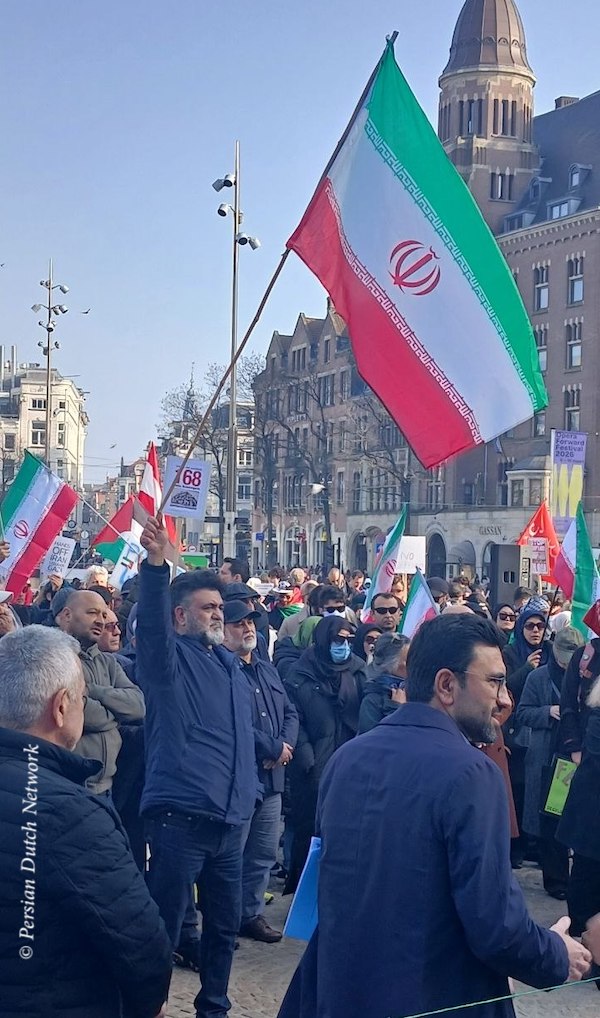
Notably, on 8 March 2026—just two months after the Iranian regime reportedly killed thousands of civilians—Mr. Roozdar organized a demonstration at Dam Square in Amsterdam appeared to be in support of the government in Tehran. Approximately 50 individuals attended, many of whom were not Iranian. According to observations and video material released from the event, organizers displayed verbally aggressive behavior, including chanting “Down with Zionists” and insulting passersby who peacefully disagreed.
This raises important questions about the legality of granting permits and police protection in the Netherlands to demonstrations that appear to support a regime accused of killing thousands of its own citizens within a matter of days. We question whether individuals expressing support for Hitler w
ould likewise be permitted to organize demonstrations in the Netherlands and chant slogans such as “Down with Zionists” in the heart of Amsterdam.
Furthermore, Nieuwsuur stated in its online coverage that “many Iranians living abroad are intimidated and threatened” by supporters of Reza Pahlavi, without providing substantial evidence. A limited number of incidents cannot be generalized to represent the broader Iranian community in the Netherlands, which numbers over 50,000 people. At the same time, the program failed to address documented instances of hostility from – for example – ultra-left and Islamist activists toward Iranian dissidents via social media. For example, a pro-Pahlavi supporter was shot in Schoonhoven on 1 March and remains in critical condition. This incident was not mentioned in the broadcast, raising concerns about selective reporting.
< Photo: Nieuwsuur featured lawyer Amin Roozdar (right), the main speaker of the demonstration in Amsterdam on March 8 to support the Islamic regime in Iran, which killed thousands of civilians in early January 2026. (Photo: Persian Dutch Network)
Since January 2026, numerous demonstrations have taken place across the Netherlands—particularly in Amsterdam and The Hague—organized by supporters of Prince Reza Pahlavi. These gatherings have been overwhelmingly peaceful, with participants advocating for freedom and solidarity with the Iranian people. While the community is naturally diverse and includes differing opinions, there has been no evidence of widespread aggression among these demonstrators, contrary to the impression suggested by Nieuwsuur.
It is important to acknowledge that all political groups include a tiny group of individuals with more extreme views. This applies not only to a small group of Pahlavi supporters but also to groups such as the Mujahedin Khalq (previously designated as a terrorist organization in Europe), as well as certain ultra-left and Islamist circles that have actively expressed hostility toward pro-Pahlavi Iranians. Another important issue is that many within the Iranian community believe that, as Reza Pahlavi is currently seen as the most serious alternative to the regime, agents linked to the regime may engage in disruptive or aggressive behavior while posing as his supporters in order to discredit him.
However, Nieuwsuur has repeatedly framed the issue in a way that portrays only Pahlavi supporters as aggressive, while also suggesting that Reza Pahlavi is backed by the United States and Israel. The selection of guests further reinforces this perception. Many invited commentators appear to be affiliated with pro-government lobbying circles or scholars with specific political ideologies. In particular, left-wing commentator Paymen Jafari has frequently appeared as a recurring guest. Several Iranian-Dutch scholars and activists have reported to the Persian Dutch Network that they have not been given the opportunity to present alternative perspectives, allegedly because their views do not align with the editorial narrative favored by the program.
Another narrative promoted by Nieuwsuur is that Pahlavi supporters advocate for US-Israeli military intervention in Iran. This characterization oversimplifies a complex reality. Following the mass killings in January 2026, many Iranians—both inside and outside the country—have called for Trump intervention, arguing that civilians are defenseless against a regime willing to use extreme violence against its own population. We may disagree with this perspective, but we cannot deny that many Iranians have expressed such views. However, their expectation was that Trump would act to prevent the regime from killing civilians—not to destroy the country’s infrastructure. Reza Pahlavi has also sought to present himself as a voice for these concerns. In this context, providing a platform to individuals such as Amin Roozdar who openly support the Iranian regime raises serious concerns about journalistic balance and the representation of pro-freedom values in the Netherlands.
We recognize that no political figure enjoys universal support, and media outlets must remain free to critique all actors. However, the consistently one-sided approach of Nieuwsuur, as a publicly funded broadcaster, risks undermining the core principles of impartial journalism in the Dutch media landscape.
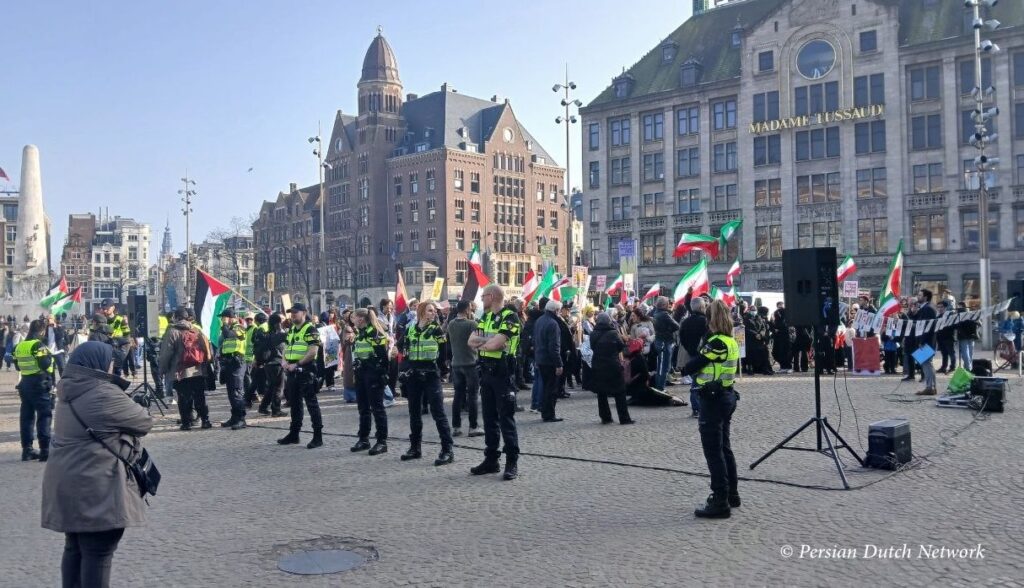
Heavy police presence at a small pro–Islamic Republic demonstration in Amsterdam. (Photo: PDN)
Grote zorgen in Perzische diaspora over berichtgeving Nieuwsuur
Het Persian Dutch Network heeft grote bezwaren tegen de uitzending van Nieuwsuur van 19 april 2026, waarin werd gesteld dat Iraniërs van alle kanten worden bedreigd.
Sinds het uitbreken van grootschalige anti-regeringsprotesten in Iran eind december 2025 heeft Nieuwsuur in zijn berichtgeving een consistent partijdige benadering laten zien. Als publiek gefinancierd programma heeft het de verantwoordelijkheid om neutraal te blijven en een evenwichtig beeld te geven van de complexe en tragische ontwikkelingen in Iran, inclusief de rol van oppositiebewegingen. In plaats daarvan lijkt het programma een redactionele koers te volgen die gericht is op het in diskrediet brengen van Reza Pahlavi, de voormalige kroonprins van Iran/Perzië—wiens naam zowel binnen Iran als in de diaspora prominent naar voren is gekomen tijdens demonstraties.
De onevenwichtige berichtgeving bereikte een dieptepunt met de uitzending van 19 april, waarin werd gesuggereerd dat aanhangers van Reza Pahlavi andere Iraniërs in Nederland bedreigen en intimideren. Een van de belangrijkste bronnen was Amin Roozdar, een in Den Haag gevestigde advocaat. In Iraanse kringen staat hij bekend als iemand die het ayatollah-regime steunt.
Opmerkelijk is dat op 8 maart 2026—slechts twee maanden nadat het Iraanse regime duizenden burgers heeft gedood—de heer Roozdar een demonstratie organiseerde op de Dam in Amsterdam, die op basis van de uiterlijke verschijningsvorm en de leuzen die werden geroepen, kennelijk diende ter ondersteuning van het Iraanse regime. Ongeveer 50 personen namen deel, van wie velen geen Iraanse achtergrond hebben. Volgens observaties en videomateriaal van het evenement waren de organisatoren verbaal behoorlijk agressief. Ze scandeerden leuzen als “Down with the Zionists” en beledigden voorbijgangers die vreedzaam hun ongenoegen daarover uitten.
Het Persian Dutch Network vraagt zich af waarom vergunningen worden verleend en politiebescherming wordt geboden aan demonstranten die zich achter een regime scharen dat in twee dagen tijd duizenden van zijn eigen burgers heeft vermoord. Zouden aanhangers van welke dictator dan ook die in Nederland de straat op willen met eenzelfde welwillendheid tegemoet worden getreden?
Online stelde Nieuwsuur dat “veel Iraniërs in het buitenland worden geïntimideerd en bedreigd” door aanhangers van Reza Pahlavi zonder daarvoor substantiële bewijzen te leveren. Ook besteedde het programma geen aandacht aan gedocumenteerde gevallen van vijandigheid van bijvoorbeeld ultra-linkse en islamistische activisten jegens Iraanse dissidenten. Zo werd op 1 maart in Schoonhoven een pro-Pahlavi-aanhanger neergeschoten en verkeert hij nog steeds in kritieke toestand. Dit incident werd niet genoemd in de uitzending. Dat duidt op selectieve berichtgeving.
Sinds januari 2026 hebben in Nederland—vooral in Amsterdam en Den Haag—talloze demonstraties plaatsgevonden, georganiseerd door aanhangers van prins Reza Pahlavi. Deze bijeenkomsten waren overwegend vreedzaam, waarbij deelnemers zich uitspraken voor vrijheid en solidariteit met het Iraanse volk. Hoewel de gemeenschap divers is en verschillende meningen kent, is er geen bewijs van wijdverbreide agressie jegens andersdenkenden. Dat staat haaks op het beeld dat in de bewuste Nieuwsuur-uitzending wordt neergezet.
Het is belangrijk te erkennen dat in alle politieke groeperingen wel een kern zit die extremere opvattingen heeft. Dit geldt niet alleen voor Pahlavi-aanhangers, maar ook voor organisaties zoals de Mujahedin Khalq (eerder in Europa aangemerkt als terroristische organisatie), evenals ultra-linkse en islamistische groeperingen.
Nog een belangrijk punt: veel Iraniërs in Iran zelf en in de diaspora zien Reza Pahlavi momenteel als het enige serieuze alternatief voor het huidige regime. Teheran is er alles aan gelegen die aanhang te ondermijnen. De optie dat mogelijke agenten van het regime verstorend en agressief gedrag vertonen terwijl zij zich voordoen als zijn aanhangers om hem zo in diskrediet te brengen, kwam bij Nieuwsuur niet aan bod. Er was alleen oog voor agressieve Pahlavi-aanhangers. Gesuggereerd werd verder dat Reza Pahlavi wordt gesteund door de Verenigde Staten en Israël.
De selectie van gasten versterkt dit beeld. Niet alleen in de bewuste uitzending, maar in het algemeen in de berichtgeving over Iran. Commentatoren lijken verbonden te zijn aan (subtiele) pro-regime lobbykringen of hebben specifieke politieke ideologieën. Zo is de linkse commentator Peyman Jafari (gepresenteerd als Irandeskundige) herhaaldelijk te gast.
Waarom steeds weer diezelfde mening? Het Persian Dutch Network krijgt van verschillende Iraans-Nederlandse academici en activisten te horen dat zij geen platform krijgen om alternatieve perspectieven te delen. Kennelijk passen hun standpunten niet in de redactionele lijn van het programma.
In Nieuwsuur wordt steeds weer herhaald dat Pahlavi-aanhangers pleiten voor een Amerikaans-Israëlische militaire interventie in Iran. Deze voorstelling van zaken versimpelt een complexe realiteit. Inderdaad: na de massamoord in januari 2026 hebben veel Iraniërs—zowel binnen als buiten het land—Trump opgeroepen tot een interventie. Vooral omdat burgers weerloos zijn tegen een regime dat bereid is extreem geweld tegen de eigen bevolking te gebruiken. Hun verwachting was dat Trump zou ingrijpen om te voorkomen dat het regime burgers blijft doden—niet om de infrastructuur van het land te vernietigen. Reza Pahlavi presenteert zich als de stem van deze zorgen.
Het Persian Dutch Network erkent dat geen enkele politieke figuur universele steun geniet en dat media vrij moeten zijn om alle actoren kritisch te bevragen. Maar de consistent eenzijdige benadering van Nieuwsuur, een publiek gefinancierde omroep, houdt zich niet aan fundamentele principes van onpartijdige journalistiek. Dat is zeer zorgelijk.
Follow PERSIAN DUTCH NETWORK on Facebook | Instagram | Twitter | Telegram | Linkedin
For the free monthly newsletter please send us an e-mail:
info [at] persiandutch.com